
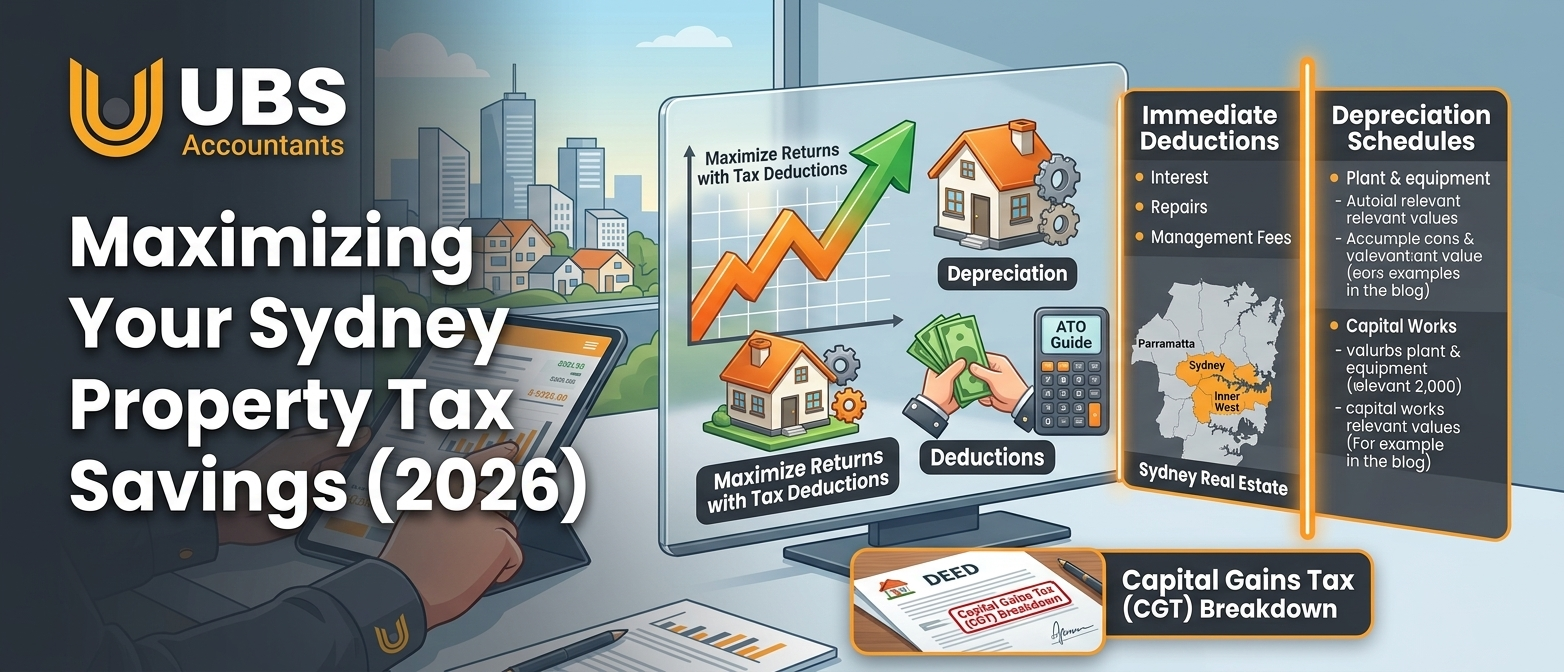
Navigating the real estate landscape across the Sydney Metro housing market requires more than just picking the right suburb. For residential property investors, managing cash flow effectively comes down to how well you handle your annual tax obligations. As land values rise and borrowing costs remain a major consideration, claiming every allowable tax deduction is essential to keeping your investment portfolio profitable.
Whether you hold an apartment in Parramatta, a family home in the Hills District, or a townhouse in the Inner West, understanding current Australian Taxation Office (ATO) legislation ensures you legally maximize your returns while remaining fully compliant. Working with an experienced Sydney real estate tax accountant helps turn complex tax laws into practical tax savings year after year.
Immediate Deductions vs. Capitalized Expenses
To establish a solid tax strategy, you must first separate expenses you can claim immediately from those you claim over several years. Following a structured ATO tax return guide for local businesses ensures no allowable deductions are missed.
According to the official ATO Rental Properties Guide, allowable immediate deductions include:
- Interest on Investment Loans: The interest charged on loans used to purchase or improve your property is fully deductible. However, if you redraw money from the account for personal expenses, you must split the interest accordingly.
- Council Rates and Water Charges: Standard local government rates and municipal water charges incurred during the period the property is rented or genuinely available for rent.
- Property Management Fees: Commissions, management costs, and lease preparation fees paid to real estate agencies. Tracking these ongoing receipts seamlessly is much easier when using cloud accounting software like Xero to categorize property expenses year-round.
- Strata Levies: Regular administrative and capital works fund contributions for apartments and townhouses. Special levies raised for major structural improvements are excluded.
- Repairs and Maintenance: Costs incurred to fix existing wear and tear, such as replacing broken roof tiles or repairing a leaking tap.
It is critical not to confuse repairs with initial repairs or capital improvements. Fixing damage that existed when you bought the property is treated as a capital expense. This adds to your cost base rather than qualifying as an immediate tax write-off.
Depreciation Breakdowns: Capital Allowances vs. Plant & Equipment
Depreciation allows property owners to write off the gradual wear and tear of a building and its internal assets over time. Claiming these paper losses requires a professionally prepared depreciation schedule property report created by a qualified quantity surveyor.
If you are carrying out major structural renovations, consulting specialized tax advisors for tradies ensures building costs are correctly categorized for Division 43 claims.
Depreciation falls into two distinct statutory categories under Australian tax law:
| Category Feature | Division 43: Capital Works Allowance | Division 40: Plant & Equipment |
| Scope | Structural elements of the building, such as concrete slabs, brickwork, roof, walls, and fixed tiles. | Removable items and mechanical assets like carpets, blinds, air conditioners, ovens, and hot water systems. |
| Deduction Rate | Fixed at 2.5% per year over 40 years for residential properties built after September 15, 1987. | Based on the specific effective life determined by the ATO for each individual asset type. |
| Second-Hand Rules | Claims continue based on original construction cost, regardless of how many times ownership changes. | Deductions are restricted for second-hand assets acquired after May 9, 2017, unless bought brand new or in a new build. |
How Negative Gearing Tax Tips Sydney Investors Can Apply Works
Negative gearing occurs when the deductible expenses generated by your investment property including mortgage interest, strata fees, council rates, and depreciation exceed the total rental income collected. This net rental loss can be offset against your other taxable income, such as your salary or business earnings.
For high-income earners or business owners managing employer PAYG withholding obligations, strategic use of negative gearing reduces overall personal tax liabilities while holding appreciating assets across prime Sydney locations. However, negative gearing should always form part of a broader cash flow strategy. Relying on non-cash paper losses like Division 40 and Division 43 depreciation allows you to reduce taxable income without incurring out-of-pocket cash costs every month.
Managing Capital Gains Tax (CGT) on Investment Sales
When selling a rental property in New South Wales, you must calculate your profit for Capital Gains Tax (CGT) purposes. Your capital gain is the difference between what you sold the property for and your overall cost base. The cost base includes the initial purchase price plus associated buying and selling expenses like stamp duty, legal fees, agent commissions, and advertising costs.
If you have owned the property for longer than 12 months as an individual, trust, or partner, you qualify for the 50% CGT discount. This cuts your taxable capital gain in half before adding it to your assessable income for that financial year.
Worked CGT Calculation Example
- Purchase Price (incl. stamp duty & legal costs): $650,000
- Sale Price (after 3 years): $850,000
- Selling Expenses (agent fees & legal costs): $20,000
- Gross Realized Gain: $850,000 − $650,000 = $200,000
- Net Capital Gain (after selling costs): $200,000 − $20,000 = $180,000
- 50% CGT Discount Applied: $180,000 × 50% = $90,000 taxable capital gain
The remaining $90,000 is added to your assessable income for that financial year and taxed at your individual marginal tax rate.
State Revenue Obligations: Land Tax NSW Thresholds
Beyond federal income tax and capital gains considerations, property owners must monitor state-level obligations managed by NSW State Revenue. Land Tax NSW applies to the total unimproved land value of all investment properties you own in New South Wales above the general statutory threshold ($1,075,000) as evaluated on December 31 each year. Proper entity structuring such as buying via trusts or adjusting your Sydney business structure setupcan significantly alter how land tax thresholds apply.
Your primary place of residence is exempt from land tax, but residential rental homes and vacant investment lots fall directly under these rules. Investors holding multiple assets within Sydney must aggregate their land holdings to determine whether their combined land value exceeds the threshold. Proper entity structuring such as purchasing through family trusts or holding property in an SMSFcan significantly alter how land tax thresholds apply to your portfolio.
Partnering with Local Property Tax Specialists
The tax landscape for real estate investors undergoes continual refinement. Failing to claim legitimate expenses means leaving money on the table, while over-claiming can invite unexpected ATO audits and penalties. Structuring your investments correctly from day one protects your wealth and streamlines annual compliance.
As your portfolio scales, combining property strategy with strategic CFO advisory serviceshelps maintain optimal cash flow across all assets.
To ensure you claim every eligible dollar and set up your investment portfolio for maximum tax efficiency, visit UBS Accountants. Their experienced team specializes in tailored property tax advice, depreciation reviews, and capital gains planning for Sydney property investors.
Ready to maximize your rental property returns and lower your tax bill this year? Book a consultation with UBS Accountants today to unlock your full deduction potential!