
Launching or expanding a business in Sydney’s fast-paced commercial market requires a solid operational foundation. Choosing the correct business structure Australia small business founders adopt is far more than a routine administrative task it fundamentally governs your personal tax liability, statutory reporting obligations, and asset protection.
Whether you are launching a tech venture in Surry Hills, taking over a trade service in Western Sydney, or structuring a commercial investment, selecting between a Sole Trader, Proprietary Limited (Pty Ltd) company, Partnership, or Trust demands careful alignment with your long-term goals.
The Four Core Business Structures in Australia
Understanding how each legal entity functions under Australian tax law helps ensure you do not expose personal assets or overpay tax as your revenue grows.
1. Sole Trader
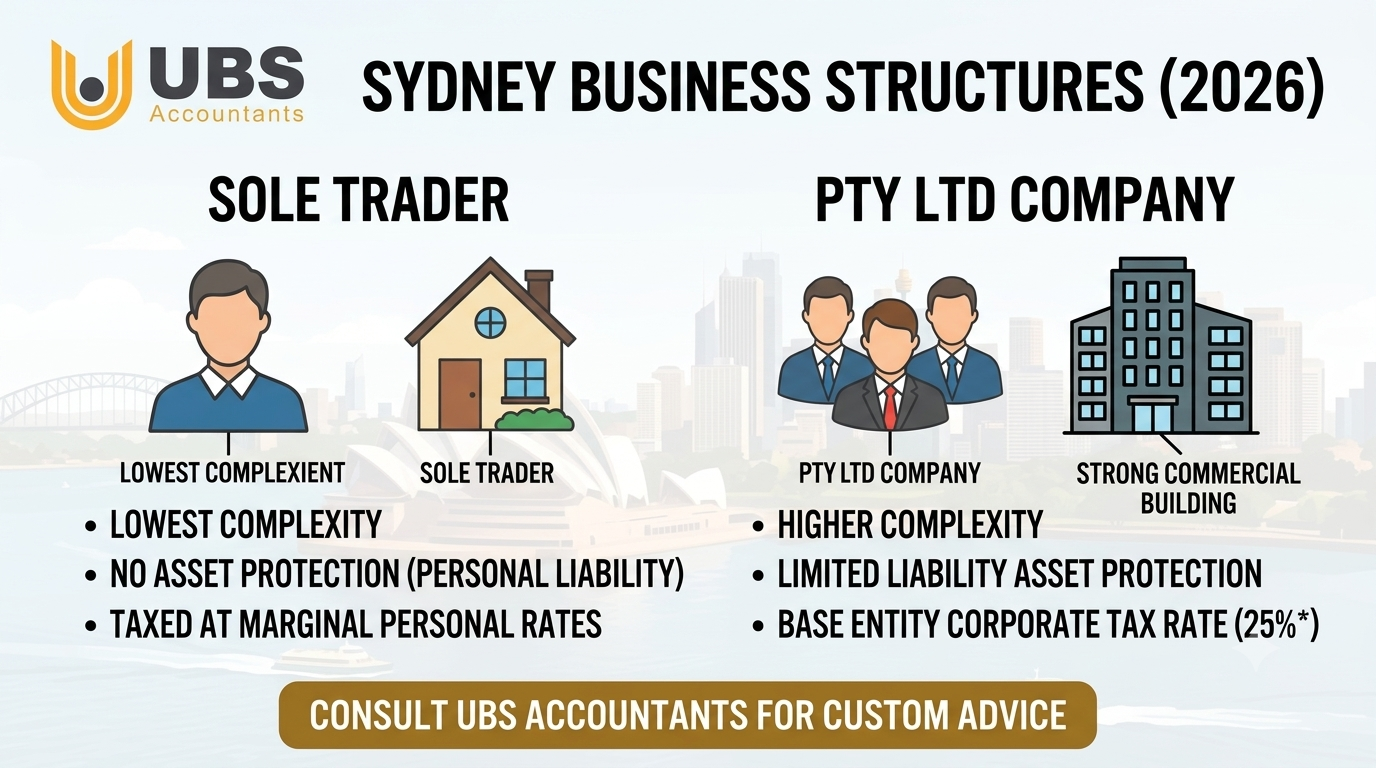
A sole trader operates as an individual with direct control over the entire business. It remains the simplest setup for freelancers, solo consultants, and micro-enterprises across Sydney.
- Taxation: Business income is declared directly on your individual tax return and taxed at personal marginal rates (plus the Medicare levy).
- Asset Protection: None. You are personally liable for all commercial debts, lawsuits, and contractual obligations.
- Setup Costs: Minimal. Requires an Australian Business Number (ABN) and a Tax File Number (TFN).
As a sole trader, staying on top of your end-of-financial-year obligations requires accurate record-keeping. You can review our small business tax return deductions guide before filing.
2. Partnership
Formed when two or more individuals or entities carry on a business together with a view to profit.
- Taxation: The partnership itself does not pay income tax. Instead, it lodges a partnership tax return, and profits/losses are distributed to partners according to their agreed shares to be taxed at their respective rates.
- Asset Protection: Limited. Partners are generally subject to joint and several liability, meaning you can be held personally responsible for debts incurred by your business partner.
3. Proprietary Limited (Pty Ltd) Company
A Pty Ltd company is a distinct legal entity registered with the Australian Securities and Investments Commission (ASIC).
- Taxation: Eligible small business entities (turnover under $50M) pay a flat 25% base rate entity company tax rate on profits retained within the business.
- Asset Protection: High. Shareholders are generally protected by limited liability, separating personal wealth (like your family home in Sydney) from company debts.
4. Discretionary or Family Trust
A trust structure holds assets or runs a business for the benefit of third parties (beneficiaries). It is frequently used by family-owned Australian businesses to manage wealth.
- Taxation: Net income is distributed annually to beneficiaries in lower tax brackets to optimize family tax liabilities.
- Asset Protection: High, especially when paired with a corporate trustee.
Business owners often integrate trusts with self-managed super funds to build long-term wealth. Review current SMSF tax compliance regulations to protect your retirement assets.
Sole Trader vs Pty Ltd Sydney: Side-by-Side Comparison
Many Sydney start-ups begin as sole traders before scaling into a corporate structure. Comparing sole trader vs pty ltd sydney operations reveals distinct trade-offs in risk, cost, and tax efficiency.
| Evaluation Metric | Sole Trader Structure | Pty Ltd Company Structure |
| Legal Status | Same legal entity as owner | Separate legal entity under ASIC |
| Asset Protection Risk | High (personal assets exposed) | High Protection (limited shareholder liability) |
| Tax Rates (2026) | Marginal individual rates (up to 45% + Medicare) | Flat 25% (Base Rate Entity) |
| Setup & Annual Costs | Very Low ($0 ABN application) | Moderate to High (ASIC registration + annual fees) |
| Compliance Load | Basic annual individual tax return | Director duties, ASIC lodging, Corporate tax return |
| Growth & Capital | Limited to personal credit lines | Ability to issue equity shares to investors |
Key Tax Considerations and Asset Protection Strategies
Selecting the wrong structure can result in severe financial friction as your revenues expand. Regardless of your structure, implementing cloud accounting software early simplifies compliance. Check out our step-by-step walkthrough on setting up Xero accounting software to keep your bookkeeping organized.
Tax Efficiency & Wealth Retention
When operating as a sole trader, earning over $135,000 pushes your marginal tax rate above 37%, eventually peaking at 45% (plus Medicare). In contrast, a company caps tax on retained trading profits at 25%. Retained earnings can then be reinvested into expanding operations, hiring staff, or purchasing equipment.
When evaluating complex operational requirements, consulting an experienced small business accountant sydney save more ensures your structure aligns with active tax minimization techniques permitted by the Australian Taxation Office (ATO).
Protecting Your Personal Wealth
If your business operates in industries carrying operational, safety, or legal risks (such as construction, medical, manufacturing, or commercial retail), operating as a sole trader puts your personal property, savings, and investments on the line.
Establishing a Pty Ltd framework acts as a legal firewall. Furthermore, high-net-worth founders often implement a family trust setup tax advice framework where a corporate entity acts as the operating company, and a discretionary trust holds shares to distribute dividends efficiently across family members.
If your business structure involves commercial or residential real estate holdings, explore the top sydneyproperty investment tax write-offs to maximize returns.
Trade contractors face unique commercial liabilities that dictate their setup choices. Learn more about specialized construction accounting and tradie tax advice.
Step-by-Step Company Registration Flowchart
For entrepreneurs ready to establish a corporate structure, this step-by-step process outlines setting up pty ltd company sydney operations smoothly:
1.Obtain Director Identification Numbers (Director IDs):Mandated statutory requirement before appointment.
Every prospective director must apply for a 15-digit Director ID through myGovID before being official appointed under ASIC guidelines.
2.Determine Company Structure and Shareholdings:Specify governance and equity distribution.
Decide who will serve as company directors and secretary (at least one director must reside in Australia). Define share classes and percentage allocations among founders or investors.
3.Register Corporate Name and Form with ASIC:Formal entity incorporation.
Check name availability on the ASIC registry and submit Form 201 to obtain your 9-digit Australian Company Number (ACN).
4.Apply for ABN, TFN, and GST Registrations:ATO tax integration.
Register your new company for an Australian Business Number (ABN) and Tax File Number (TFN). Register for Goods and Services Tax (GST) if projected annual turnover reaches or exceeds $75,000.
5.Establish Corporate Banking and Compliance Registers:Operational readiness.
Open a dedicated corporate bank account and set up statutory registers (minute books, member registers, share certificates) to adhere to ongoing corporate governance laws.
Following a structured approach reduces delays when launching new ventures. You can explore a detailed walkthrough via our complete step by step guide how to register a business in sydney resource.
When Should You Restructure Your Business?
If you started as a sole trader, your initial setup might no longer serve your business as revenue climbs. You should consider restructuring if:
- Net profits exceed $120,000–$150,000 per year: Capping tax liabilities at the corporate rate becomes financially advantageous.
- You hire staff or take on high-value contracts: Expanded operations increase commercial liability risk.
- You intend to bring on co-founders or equity investors: Sole trader setups cannot issue equity or handle external investment.
- You are planning succession or wealth transfer: Structuring through trusts simplifies intergenerational asset transfers.
Executing a structure conversion requires careful management of Capital Gains Tax (CGT) events and duty liabilities. Engaging an experienced business structuring accountant ensures you access CGT small business rollover concessions without triggering unnecessary tax events.
Transitioning into a company structure often comes with hiring employees. Make sure you understand payroll tax and PAYG withholding requirements to stay fully compliant with the ATO.
If complex financial planning and rapid growth are overwhelming your internal operations, consider virtual CFO advisory services to scale strategically.
Strategic Advice from UBS Accountants
Choosing between a Sole Trader, Pty Ltd, or Trust configuration shapes your commercial trajectory, reporting obligations, and long-term security.
At UBS Accountants, we work alongside Sydney founders, family businesses, and growing companies to build resilient, tax-optimized business foundations.
Whether you need tailored advice on setting up pty ltd company sydney entities or require strategic growth insights, consulting a qualified business advisor australia can do to help your company thrive ensures your business is positioned for sustainable profit from day one.