
Every financial year, thousands of Sydney business owners scramble in the final weeks before lodgement, digging through shoeboxes of receipts and half-updated spreadsheets.
A proper tax return checklist backed by an experienced small business tax accountant in Sydney makes the difference between a smooth lodgement and a stressful one or worse, an ATO review. This guide walks through exactly what Sydney CBD businesses need to prepare, claim, and record before tax time, so you can lodge with confidence and keep more of what you earn.
Why a Structured Checklist Matters
The Australian Taxation Office (ATO) doesn’t just want a number on a form it wants evidence behind every figure you report. Missing documentation, inconsistent BAS lodgements, or unclaimed deductions are among the most common reasons small businesses either overpay tax or attract ATO attention.
If you’ve ever wondered what a tax agent actually does to keep you off the ATO’s radar, a well-organised checklist is where that protection starts.
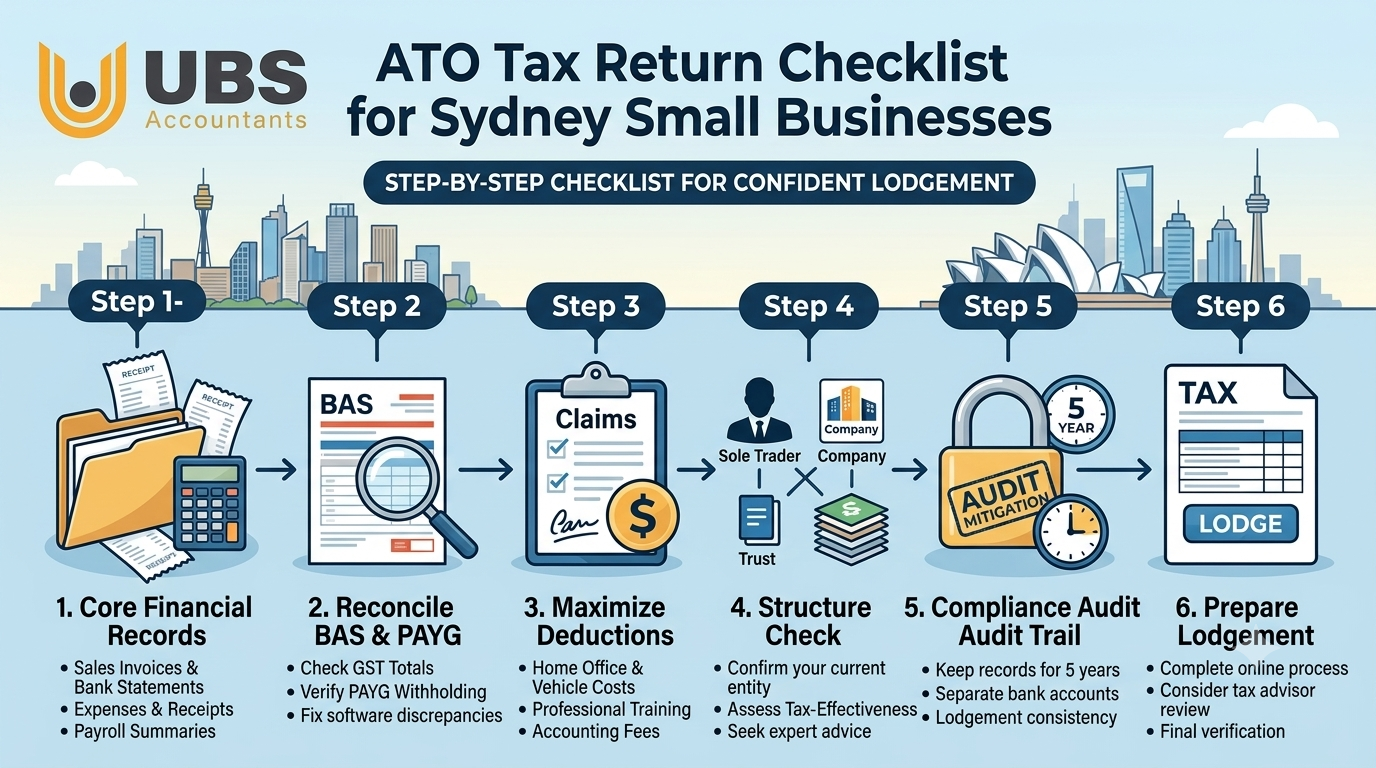
Step 1: Gather Your Core Financial Records
Before you touch a tax form, pull together:
- Income records: sales invoices, bank statements, and merchant statements for the full financial year
- Expense records: supplier invoices, receipts, and subscription statements
- Payroll data: wages, superannuation, and PAYG withholding summaries for any employees
- Loan and asset documents: equipment finance agreements, vehicle logs, and depreciation schedules
Having your numbers organized in cloud accounting software like Xero makes reconciling your quarterly BAS statements and pulling annual tax reports significantly faster.
If your bookkeeping has fallen behind, this is the moment to catch up rather than patch things together at the last minute.
Solid ongoing bookkeeping is genuinely the backbone of every small business’s financial health, and it’s far cheaper to maintain than to reconstruct.
Step 2: Reconcile BAS and PAYG Withholding
Your quarterly Business Activity Statement (BAS) figures should tie back exactly to your annual tax return. Discrepancies between BAS-reported GST and your final income figures are a common trigger for ATO queries. Check that:
- GST collected and claimed matches your accounting ledger
- Ensure that your superannuation contributions and superannuation and employer PAYG withholding compliance align perfectly with your Single Touch Payroll (STP) reports before finalizing your lodgement.
- Any BAS adjustments or corrections have been properly documented
If BAS reconciliation still feels unclear, our guide to understanding BAS obligations for small business owners breaks down what is required each reporting quarter.
Step 3: Identify Every Eligible Deduction
If you hold commercial or residential real estate alongside your business, maximizing tax claims on Sydney property investments such as interest expenses and depreciation schedules can provide additional tax relief. Commonly missed small business tax deductions Australia offers include:
- Home office running costs (if you work from home part of the time)
- Professional development, training, and industry memberships
- Vehicle, tool, and equipment claims require strict proof, which is why specialized accounting advice for Sydney tradies is essential for contractors navigating heavy equipment write-offs.
- Software subscriptions, accounting fees, and business insurance
- The Instant Asset Write-Off for eligible equipment and asset purchases within the current threshold
The Instant Asset Write-Off in particular changes from year to year, so it’s worth confirming current eligibility before assuming an asset qualifies.
For a fuller breakdown, see our complete guide to common tax deductions small businesses miss across Sydney.
Step 4: Confirm Your Business Structure Is Working for You
Sole traders, partnerships, companies, and trusts each carry different reporting obligations and tax rates. Incorporating proactive tax planning for small businesses in Sydneyensures you aren’t overpaying on corporate tax or operating under an outdated legal structure.
This is a conversation worth having with a qualified advisor rather than guessing get in touch through contact us if you’d like a second opinion before lodgement.
Step 5: Apply ATO Audit Mitigation Practices
ATO tax compliance Sydney businesses should treat as standard practice rather than a once-a-year scramble includes:
- Keeping digital copies of all receipts for at least five years
- Separating business and personal bank accounts completely
- Maintaining a clear, dated audit trail for every deduction claimed
- Lodging BAS and superannuation on time, every quarter, without exception
Late or inconsistent lodgement history is one of the clearest red flags the ATO’s risk-detection systems look for. Businesses with clean, on-time records are simply less likely to be flagged for review in the first place.
Step 6: Prepare for Lodgement
Once your records are reconciled and deductions identified, you’re ready to lodge. If you’re filing directly, our guide to lodging your tax return online walks through the process.
Beyond standard tax prep, growing companies that need higher-level strategic insight often benefit from virtual CFO strategic advice to plan for future cash flow and long-term tax efficiency.
End of Financial Year Checklist: WA, NSW and Beyond
While ATO rules are federal, state-based obligations like payroll tax thresholds, workers’ compensation, and stamp duty considerations differ across NSW, WA, and other jurisdictions. Sydney CBD businesses should specifically check:
- NSW payroll tax thresholds if wages have grown this year
- Business owners using self-managed funds to hold commercial premises or invest profits should also maintain strict SMSF tax compliance standards during end-of-year reconciliations.
- Any industry-specific reporting requirements relevant to your sector
If you operate across multiple states, it’s worth confirming which state-specific rules actually apply to your business before assuming last year’s approach still holds.
Download Your Free PDF Checklist
To make this process easier, we’ve put together a downloadable PDF version of this ATO tax return checklist, designed specifically for Sydney small businesses. It covers every item above in a printable, tick-box format you can work through with your bookkeeper or accountant.Request your copy through our contact formand we’ll send it straight to your inbox.
Get Expert Help Before You Lodge
Tax time doesn’t have to be stressful.Our Sydney taxation team works with small businesses across the CBD and greater Sydney to reconcile records, maximise legitimate deductions, and lodge with confidence.
Whether you need help catching up on bookkeeping, reviewing your BAS, or simply want a second set of eyes before this year’s return goes in, we’re here to help.
Reach out today and make this the last tax season you spend guessing.